
Single Post
The AI Revolution: Transforming Web Development, Digital Marketing, and UI/UX in 2026
Share
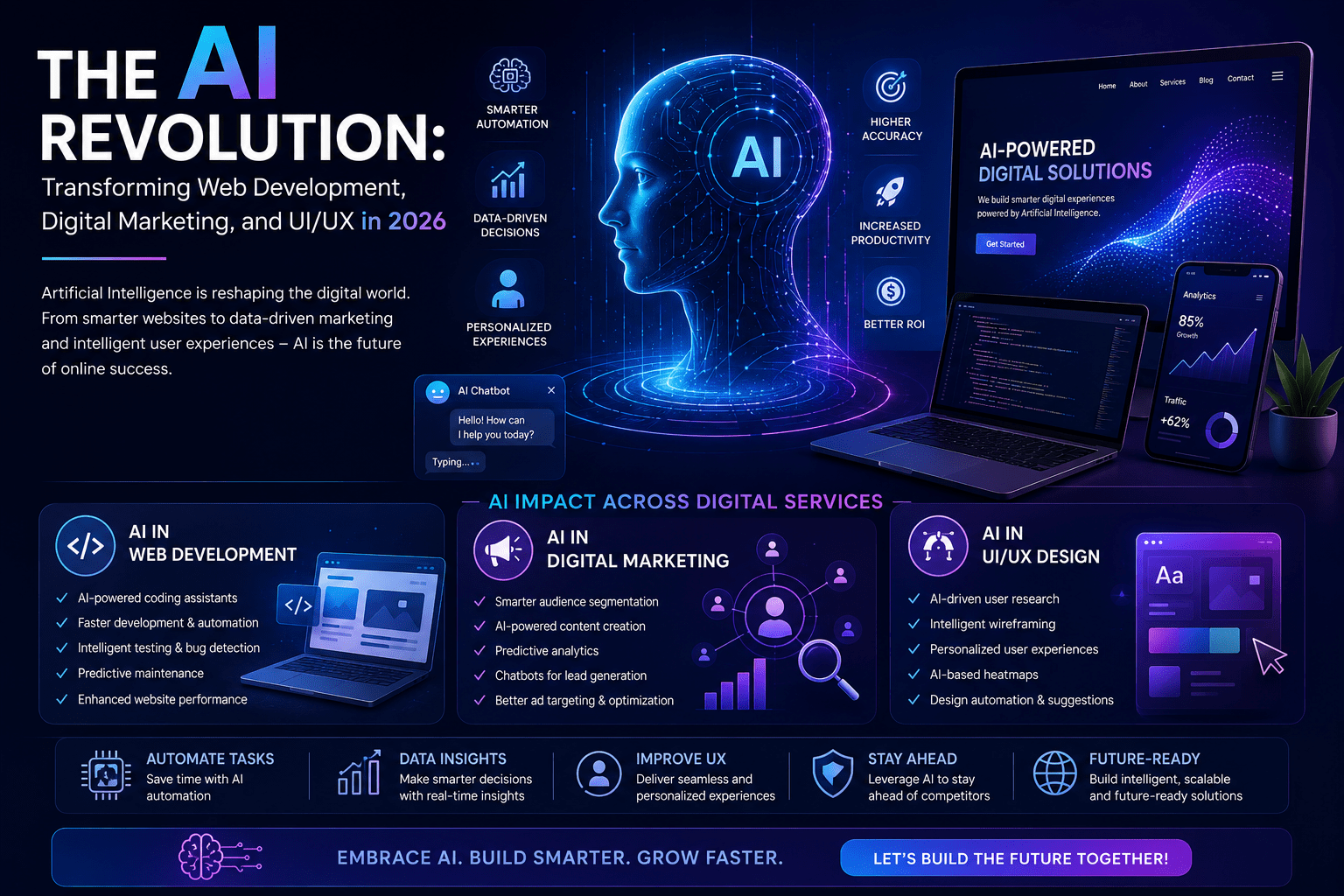
The digital landscape in 2026 has reached a tipping point. What were once “experimental” AI tools are now the foundational engines driving the global economy. For website design and development companies, digital marketing firms, and UI/UX service providers, the integration of Artificial Intelligence is no longer a luxury—it is the standard for survival and growth.
This article explores how AI is fundamentally reshaping these sectors and what service-based companies must do to stay competitive in an agentic, hyper-personalized world.
AI in Website Design and Development: From Static to Adaptive
In 2026, the traditional “build-and-launch” cycle is dead. Modern website development companies are moving toward Adaptive Web Architectures.
The Rise of Generative Coding and “Agentic” Developers
AI is no longer just autocomplete for code. Generative AI now analyzes high-level project specifications and writes entire functional modules, handling repetitive backend logic and boilerplate code. This allows developers to evolve into “Architects,” focusing on high-level strategy and security.
Automated Debugging: AI agents now perform continuous, real-time testing, identifying and fixing bugs before a human developer even sees the error log.
Low-Code/No-Code Fusion: AI-powered platforms allow agencies to build complex, enterprise-grade web applications with a fraction of the manual labor, drastically reducing Time-to-Market (TTM).
Predictive Layouts and Edge AI
Websites in 2026 are not static templates. Edge AI (processing data locally on the user’s device) allows sites to adjust layouts in milliseconds based on real-time user intent. If a user’s behavior suggests they are looking for technical documentation rather than pricing, the AI reorders the navigation and content hierarchy instantly.
Digital Marketing: The Era of Hyper-Personalization
For digital marketing companies, 2026 is the year of “The Segment of One.” AI has moved past basic demographic targeting into Predictive Customer Journeys.
AI-Driven Content Strategy
Content creation is now a collaborative effort between humans and AI. While human marketers provide the brand voice and emotional resonance, AI handles:
Omnichannel Adaptation: Automatically rewriting a single blog post into 50 different formats, from TikTok scripts to LinkedIn carousels, while maintaining brand consistency.
Real-Time Sentiment Analysis: Marketing tools now monitor social discourse in real-time, allowing brands to pivot their messaging instantly based on the emotional “temperature” of their audience.
The Shift in SEO (Search Engine Optimization)
SEO has evolved into GEO (Generative Engine Optimization). With users getting answers directly from AI assistants, agencies now focus on:
Entity-Based Authority: Ensuring a brand is recognized as a “source of truth” by AI models.
Voice and Visual Search: Optimizing for natural language queries and image-based “find-and-buy” behaviors.
UI/UX Services: Designing for the User and the AI
UI/UX service providers are seeing the biggest shift in design philosophy. We are moving away from “Generic Design” toward Generative UI.
Generative UI and Dynamic Interfaces
Instead of designing a single interface, UX designers now create Design Systems with Rules. The AI then generates the specific UI on the fly for each user.
Accessibility Automation: AI now ensures every element meets WCAG 2.0+ standards automatically, adjusting contrast, font size, and navigation paths for users with different needs.
AI Design Assistants: Tools like Figma AI and Galileo AI enable designers to generate high-fidelity prototypes from simple text prompts, cutting the prototyping phase by over 50%.
From Click-Throughs to Conversations
With the rise of Conversational AI, the “User Interface” is often no longer a screen of buttons. UX designers are increasingly focused on VUI (Voice User Interfaces) and CUI (Conversational User Interfaces), where the goal is to make digital interactions feel as natural as talking to a friend
Traditional Model (Pre-2024) AI-Driven Model (2026) Manual coding and bug fixing AI-generated code with human oversight Static A/B testing Continuous AI optimization Generic content calendars Real-time, data-driven content generation Fixed UI templates Generative, adaptive user interfaces The Competitive Edge in 2026
AI is not replacing website design and development companies or digital marketing agencies; it is supercharging those who embrace it. By automating the “drudge work,” these companies can focus on what truly matters: building deep brand connections and solving complex business problems.
To remain a leader in this landscape, service providers must invest in Agentic AI workflows, prioritize first-party data, and transition from being “builders” to becoming Strategic AI Partners
“The value no longer lies in the execution—which AI can do—but in the strategy, ethics, and creative direction that only humans can provide.”
Written by

Janardhan Reddy
Founder & CEO